- 4. Slaves and the Free Burghers
Slaves lost their names and were given names relating to their origin or birth. eg. “van de Kaap” born at the Cape, South Africa; van Macasser; van Angola; van Bengal; van Malabar. Children born to slaves remained slaves. However if a slave was emancipated and married or had a child from her owner or other European, and the father recognised the child as his, then those children born to that relationship were free from slavery.
History of slavery and early colonisation in South Africa.
Jan van Riebeeck, who founded the first colony at Cape Town in 1652, was an official of the Dutch East India Company (VOC). The Dutch marked their permanence by building a five-pointed stone castle on the shores of the bay, a structure that continues to dominate the city centre of Cape Town. From within the walls of the Castle, the VOC administered and governed the expanding colony.
At first, the Dutch were primarily concerned with supplying their ships with fresh produce as they rounded the Cape en route to the spice-producing islands of the Indonesian archipelago. This is because the Dutch had their most important colonial interests in Indonesia, which included the growing of crops and spices that could not be produced in Europe. In Indonesia, the Dutch enslaved entire populations, ruling them by force and coercing them to produce crops. In the Cape, Van Riebeeck first attempted to get cattle and labour through negotiation, but as soon as these negotiations broke down slavery was implemented.
Even with slavery, the Dutch did not have sufficient labour power to provide for their ships. In 1657, some Company officials were released from their contracts (with VOC) and were allocated land along the Liesbeeck River. The first title deeds were granted around a clump of thorn trees called “Het Ronde doornbosjen” – now simply called Rondebosch. These officials became known as the Free Burghers, and formed the nucleus of the white South African population that came to be known as Boers or Afrikaners. None of these very first free burghers appear in our family tree.
It soon became apparent that if the free burghers were to be successful as agricultural producers, they would need access to substantial labour. The indigenous peoples with whom the Dutch first came into contact, the Khoikhoi, had been settled in the region for at least a thousand years before the Dutch arrived, and were an unwilling labour force. This is because the Khoikhoi were a pastoral people, and as long as they had their lands, flocks of sheep and herds of cattle, they could not be pressed into service for the Dutch settlers.
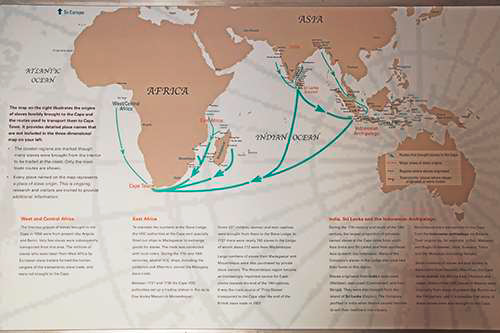
The Dutch settlers were therefore forced to look elsewhere for their labour needs. In 1658, a year after the first free burghers had been granted their plots of land, the first slaves were imported into South Africa, specifically for agricultural work. These slaves arrived at the Cape on 28 March 1658 on board the Amersfoort and had been captured by the Dutch from a Portuguese slaver en route to Brazil. Of the 250 slaves captured, only 170 survived the journey to the Cape. Most of these slaves were originally captured by the Portuguese in present-day Angola. On 6 May 1658, 228 slaves from another group arrived at the Cape on board the Hassalt, from Ghana. From 1710 onwards, the adult slave population outnumbered the adult colonial population by as much as three to one.
Another source of slaves was the VOC’s return fleets from Batavia and other places in the east which sailed around the Cape on their way to Europe. VOC officials could not take their slaves with them when they returned home, as slavery was illegal in the Netherlands. Therefore, many of these officials sold their slaves at the Cape because they could get a better price for their slaves there than in the East Indies. Foreign ships on their way to the Americas from Madagascar also sold slaves at the Cape.
Baptism and Identity Creation at the Cape of Good Hope, 1665 to 1840 by VC Malherbe (Centre for Socio-Legal Research, University of Cape Town) states:-
- Every child of a Christian believer should be baptised, including those born out of wedlock. The exceptions to this were children domiciled with a non-Christian mother, non-Christian were also muslims and Jews.
- Baptism was a prerequisite for marriage in the Reformed Church – and Christian marriage was the only legal marriage at the Cape. Slaves were not married, so their children were all born out of wedlock. Marriages of Muslims and Jews were illegal marriages at the Cape.
- Slaves were either privately owned or owned by the Dutch East India Company (VOC). These slaves from the VOC lived in the Slave Lodge at the Cape. All the slaves in the Slave Lodge were baptised in 1666.
Following slaves appear in our family tree:-Dorothe van Angola, born approximately 1655. In the First Fifty Years Project by Delia A. Robertson (https://web.archive.org/web/20240413221818/http://e-family.co.za/ffy/index.htm); it says “On 14 October 1657 the Amersfoort departed Vlie enroute to de Caep de Goede Hoop where it docked on 28 March 1658. With more than half the journey completed, on 23 January 1658, probably off the coast of Angola, the Amersfoort sighted a Portuguese slaver with 500 slaves on board. After a 24-hour chase, the vessel was captured, and 250 slaves were taken aboard the Amersfoort for the journey to the Cape. The crippled Portuguese vessel was abandoned to whatever fate might befall her, 250 slaves and her crew. Of the 250 slaves captured, when the Amersfoort heaved in Table Bay two months later, only 174 had made it alive, most of them, according to Jan van Riebeeck “girls and small boys” – among them was Dorothe van Angola.”
She gave birth to a girl Cecilia Swerisse, father unknown. The daughter was owned by the VOC. Cecilia was in a relationship with N. Kemp, and in turn gave birth to a girl, Jannetje (or Johanna). Johanna was also owned by the VOC. She married Jacob Kruger and became the Stammoeder of the Krugers.
Catherina van Paliacatta who was born around 1631 near Bengal, India. She was a slave woman from Paliacatte, on the Coromandel Coast of India. (Source Mansell Upham). She was a slave in Batavia to the free woman Maria Magdalena (we don’t know whether she had a surname).
She was sexually assaulted on 8 October 1656 by her lover, the slave Claes van Malabar, in a stable at the Fort Rijswijck. In the conflict, she hit Claes with a ladder across his stomach. Claes died four days later since his bladder had burst. Catharine then faced charges of murder and received the death sentence. She was however pardoned, being banished as a slave to the Cape. She arrived at the Cape on 21 February 1657 on the ship Prins Willem. This ship was part of the return fleet which left Batavia on 4 December 1656. She was the first recorded female slave convict at the Cape.
She had 2 voorkinders (prior children), one by the ensign and chief of the garrison, Pieter Everaerts from Bruijsaert and one by the soldier Hans Christoffel Snijder (this is the Dutch version of Schneider) also known as Snijman, from Heidelberg in the Palatinate; now part of Germany. At the Cape Catharina van Paliacatta was also known as Groote Catrijn.
Hans Christoffel Snijman (also recorded as Christoffel Snijman) was a soldier in the garrison convicted and banished to Robben Island on 30th July 1667 for not standing guard – instead he had been sleeping on a regular basis with Groote Catrijn – washerwoman at the Fort to successive commanders. Thereafter, Snijders disappears from the records at the Cape. On instructions from the Council of India, Groote Catrijn was again pardoned.
Their son named Christoffel Snyman is your forefather, he was baptised on 9 March 1665 at Cape Town. He became the Stamvader of all the Snyman is South Africa.
Groote Cathrijn then gets baptised herself as an adult with her fellow slave friend Mooij Ansela on 29 April 1668.
Catharina later married a free black Anthonij (Jansz) (de Later) van BENGALE on 20th December 1671. In a letter dated 6 January 1672 it is mentioned that Groot Catrijn was freely pardoned.
Groote Catrijn, her husband, her daughter and granddaughter – with the exception of Christoffel Snijman Jnr appear to have all died, in some family tragedy sometime between December 1682 and February 1683.
Antjonij Jansz van Bengale’s sizeable estate provided for the boy’s (Christoffel Snyman) education and a substantial inheritance. Christoffel Snyman was the stepson of Anthonie van Bengale.
Source: M. Upham “In Hevigen Woede … Groote Catrijn: Earliest Recorded Female Bandiet at the Cape of Good Hope – A Study in Upward Mobility” Capenis, Sept 1997.
Ansela van de Kaap; “van de Kaap” shows she was born at the Cape as a slave; approximately 1670, her mother must have been a slave. Ansela was a slave owned by the VOC. Her parents are unknown.
She married Lourens (Lorenz) Campher, he was employed by the VOC and came from a town called Mohrow in Pommerania, Prussia. Now it is part of Poland. Their daughter Agnita Campher is your distant gr.gr.gr… grandmother. [Ferreira and Dreyer]
Catharina van de Kaap* born around 1658 at Cape Town. Catharina van de Kaap was born in bondage [means the state of being under the control of another person; means she grew up as a slave] and was owned by the VOC (Vereenigde Oostindische Compagnie). Catharina’s mother was most likely one of the slaves brought to the Cape on the Amersfoort in 1658. Those slaves had originally been captured in Angola, which country shares a modern border with Zambia.
On 21 March 1683 she married Andries Beyers from Saxony, now part of Germany, at NGK in Cape Town. Andries Beyers arrived at the Cape as a soldier employed by the VOC. In 1672 he was a “knecht” [worker] for the wagonmakers Cornelis Wycksteyn. Catherina van de Kaap was also known as Catharina Wagenmakers, named after her husbands occupation.
Dorothea Florentine (Wilhelmina) Jansen van de Kaap is the most recent “slave” in the family tree. [Dreyer] She was born in Cape Town around 1773. Having the surname of “van de Kaap” means she was born as a slave. A very interesting read is Cape Melting Pot by Hans Heese and translated by Delia Robertson. See the next Blog looking closer at Dorothea.
Free Burgers
The VOC operated as a “company-state”. When the Dutch Republic (Netherlands) issued its charter in 1602, it granted the VOC sovereign powers normally reserved for independent countries. This included the legal authority to wage wars against other ships, build fortresses, sign treaties, conquer territories, and maintain its own standing military forces.
When men signed up to work for the VOC in Europe, they generally entered into a binding labour contract for specific roles. The Merchants and Administrators were mainly Dutch citizens who held high-ranking managerial, bureaucratic, and commercial roles. The sailors were responsible for the grueling work of navigating, maintaining, and sailing the massive merchant fleets across the globe. Finally, the soldiers were hired to guard the ships against pirates and enemy nations during transit, defend colonial trade monopolies, and staff fortresses onshore.
Because the population of the Dutch Republic (Netherlands) was relatively small, the VOC struggled to find enough domestic labor to fill the lower-tier, highly lethal jobs on ships and in garrisons. To solve this, they recruited throughout Europe; especially from impoverished, war-torn regions of Germany. Consequently, about 75% of the VOC’s army consisted of foreign European mercenaries who signed up explicitly as professional soldiers to escape poverty or social strife at home.
In the very early years at the Cape, the only way to settle there was to be employed by the VOC and to request to be released from the VOC’s contractual obligations and apply for burger rights at the Cape. The majority of the employees of the VOC were referred to as soldiers. The VOC only allowed persons to settle if their debts to the VOC had been settled or a good chance to settle their debt in the near future. In Dutch vryburger or vrijburgher, was given when a soldier or other employee of the VOC was released from their contractual obligations to the VOC and permitted to farm, become a tradesman, or work for others at the Cape of Good Hope.
Almost all, except the Huguenots and 1820 Settlers, in your family tree were employed by the VOC.